
Concepts · Leadership
The Power of YES and a Positive Mindset
The foundation of successful leadership

Dr Raghunandan Jagdish
Founder, Nandan GSE · 15 min read
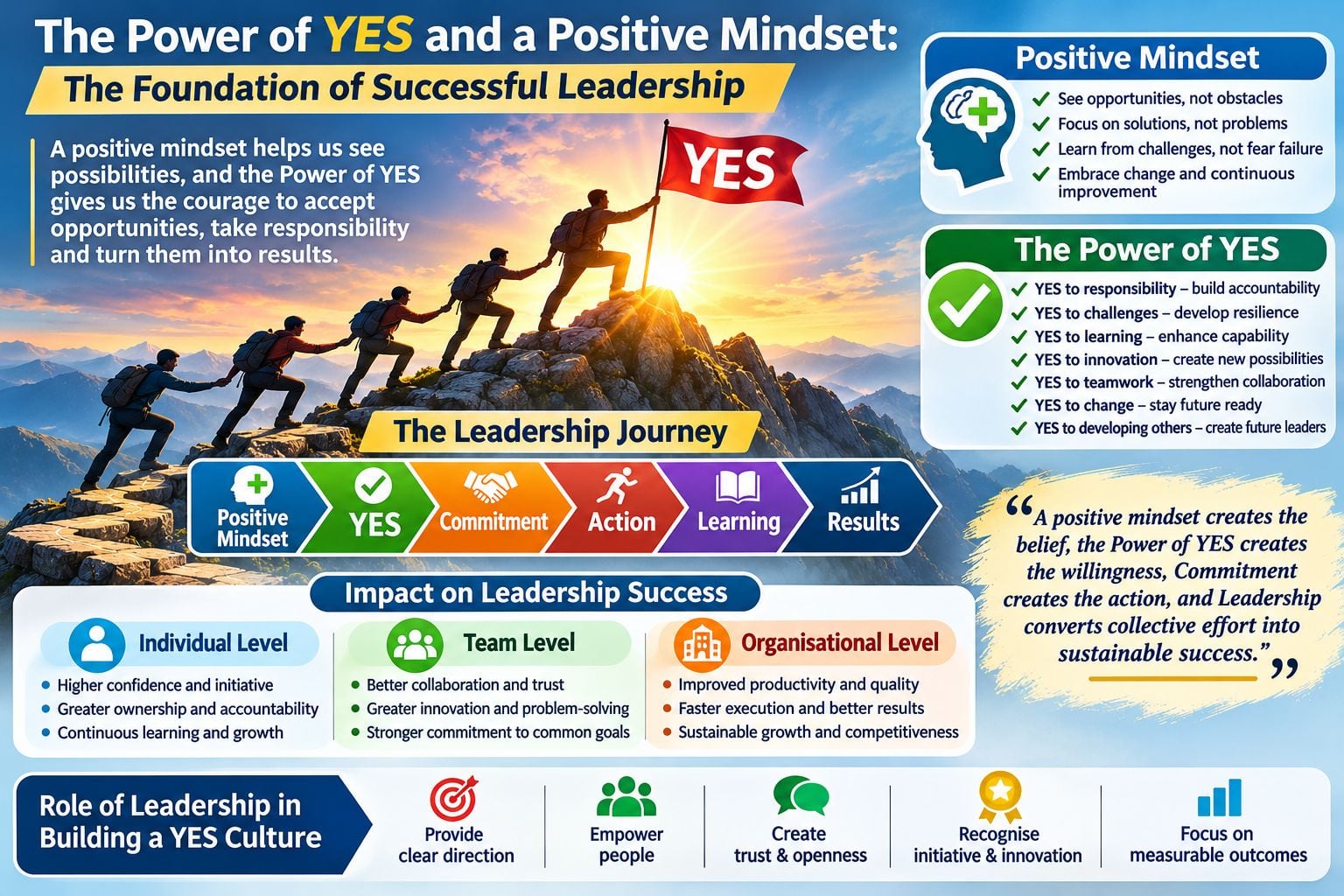
Can a change in mindset transform leadership behaviour and organisational success?
I believe the answer lies in two powerful concepts: Positive Mindset and the Power of YES.
Leadership is not merely about position, authority or achieving targets. It is about how we think, respond to challenges, accept responsibility and inspire others.
1 · The foundation
Positive Mindset
A positive mindset enables leaders to see opportunities where others see obstacles, solutions rather than problems, and learning rather than failure.
Instead of asking…
Why can’t we do it?
How can we do it?
Why should I take responsibility?
How can I contribute?
What if we fail?
What can we learn?
Why change?
What can we improve?
Positive thinking does not mean ignoring difficulties; it means approaching them with confidence, rational thinking and a solution-oriented attitude.
The same habit, at the factory and in the office
“The customer is being unreasonable.”
→ What is the customer really worried about?
“We have always done it this way.”
→ What would we do if we started today?
“That is not my department.”
→ Who should I connect this to, and by when?
“We don’t have the budget.”
→ What is the smallest version we can try this month?
2 · Converting thinking into action
The Power of YES
YES is more than agreement. It represents willingness, courage, ownership and commitment.
YES to responsibility builds accountability.
A supervisor says “I own the dispatch delay” before anyone asks who caused it.
YES to challenges develops confidence and resilience.
An engineer volunteers for the difficult customer audit instead of the easy one.
YES to learning enhances capability.
A manager asks the team to teach them the new software, and learns in front of them.
YES to innovation creates possibilities.
A small trial of an operator’s idea runs this week instead of “after the budget”.
YES to teamwork strengthens collaboration.
Purchase and production plan the month together, in one room.
YES to change keeps us future-ready.
A new process is tried for thirty days before anyone judges it.
YES to developing others creates future leaders.
A senior person hands over a customer relationship and coaches, instead of holding on.
However, meaningful YES is not blind agreement. It must be supported by knowledge, facts, risk assessment and commitment to execution.
Every YES is a NO to something else
Time and attention are limited. A leader who says YES to everything ends up delivering little. The strongest YES often comes with a clear NO, or “not now”, to something less important, so the YES can be kept.
A good NO can come before a strong YES
Disagreement is not negativity. Raise the risk, question the plan, offer the alternative. Once the decision is made, give it your full YES. That is how a team gets both honesty and commitment.
Try it
The YES test
Six questions to turn a quick yes into a meaningful YES. Use it before you take on a project, a target or a promise to a customer.
Before you say YES to something significant, tick what is true:
Not yet. (0 of 6)
A YES now would be a blind YES. Ask for what is missing first; a positive “not yet, here is what I need” is still a positive answer.
3 · Why it matters
Impact on leadership success
The combination of Positive Mindset and YES creates impact at three levels.
Individual
- Greater confidence
- Initiative and ownership
- Professional growth
On a Monday morning: People bring solutions with their problems, and volunteer before being asked.
Team
- Stronger collaboration and trust
- Innovation
- Collective accountability
On a Monday morning: Meetings end with names and dates; mistakes are raised early, not hidden.
Organisation
- Improved productivity and quality
- Faster execution
- Customer satisfaction and sustainable growth
On a Monday morning: Decisions move faster because fewer of them have to climb to the top.
4 · From thought to results
The Leadership Journey
Positive thinking creates belief. YES creates willingness. Commitment drives action. Learning builds capability. Collective effort delivers results.
- 1Positive Mindset
Positive Mindset creates belief.
Where it breaks: Optimism that ignores facts. Belief needs evidence.
- 2YES
YES creates willingness.
Where it breaks: A YES with no owner, no date and no resources.
- 3Commitment
Commitment drives action.
Where it breaks: Commitments made in the meeting and forgotten by Monday.
- 4Action
Action moves the work.
Where it breaks: Starting many things, finishing few.
- 5Learning
Learning builds capability.
Where it breaks: Blame after a setback, so the lesson is hidden.
- 6Results
Results delivers sustainable success.
Where it breaks: Celebrating the number, forgetting the people and capability that produced it.
5 · Building a YES culture
The role of senior leadership
Building a YES culture requires leaders to provide clear direction, empower people, encourage openness, recognise initiative and focus on measurable outcomes.
01
Provide clear direction
People can only say a confident YES to a goal they understand.
Do this week
Write the three priorities for this quarter on one page and share it with everyone who reports to you.
02
Empower people
A YES means nothing if the person has no authority to act on it.
Do this week
Name one decision you currently make that someone closer to the work could make, and hand it over.
03
Create trust and openness
People will not say YES to a risk in a place where mistakes are punished.
Do this week
In one meeting, ask “What am I missing?” and thank the first person who disagrees.
04
Recognise initiative and innovation
What gets recognised gets repeated.
Do this week
Recognise one person publicly for trying something, even if it did not fully work.
05
Focus on measurable outcomes
Positive energy must convert into results, or it turns into slogans.
Do this week
Pick one number your team can move in 30 days and review it every Monday.
Where are you today?
The YES culture check
Ten statements, two minutes. Do it alone, then ask your team to do it and compare. Nothing you enter leaves this page.
Rate each statement for your team: 1 = rarely true, 5 = almost always true.
1.When a problem appears, people first ask “how can we fix it?” rather than “who did it?”
2.People volunteer for difficult work without being told.
3.Someone junior can disagree with a senior leader in a meeting, and nothing bad happens.
4.Mistakes are reported early and treated as lessons.
5.Every meeting ends with clear owners and dates.
6.Everyone can name the team’s top three priorities.
7.People have the authority to act on what they say YES to.
8.Initiative is recognised, even when the result was not perfect.
9.Leaders spend time developing people, not only checking results.
10.We review a few measurable outcomes regularly and act on them.
0 of 10 answered. Your result appears when all ten are rated.
Put it to work
A 30-day plan to build a YES culture
Week 1
Change the language
- Put the four reframes on the meeting-room wall.
- In every meeting, when you hear “Why can’t we?”, ask “How could we?”
- Start each team meeting with one thing that went well and why.
Week 2
Make YES specific
- Use the YES test before you take on anything significant.
- Every YES in a meeting gets an owner and a date, written down.
- Say one honest “not now” to protect a bigger YES.
Week 3
Build safety and learning
- Ask “What am I missing?” and thank the first dissenter.
- Run a short pre-mortem on one project: imagine it failed; list why.
- Share one mistake of your own, and what you learned.
Week 4
Recognise and measure
- Recognise three people publicly for initiative.
- Review the one number your team chose, together, every Monday.
- Ask the team to run the culture check again and compare.
Five questions for your next team meeting
- 1.Where in our work do we most often say “Why can’t we?” What would “How can we?” change there?
- 2.Think of a YES you gave that you regret. What was missing: facts, risk thinking, capacity or commitment?
- 3.When did someone in this team last disagree with a senior person? What happened next?
- 4.Which decision could move one level closer to the people doing the work?
- 5.What should we stop doing to make room for our most important YES?
My leadership thought
A positive mindset changes how we see the world. The Power of YES changes how we respond to it.
An individual’s YES
can initiate change.
A leader’s YES
can inspire a team.
A collective YES
can transform an organisation.
Ultimately, leadership success is not measured only by targets achieved, but also by the trust created, people developed, capabilities built and positive changes delivered.
A Positive Mindset creates the belief, the Power of YES creates the willingness, Commitment creates the action, and Leadership converts collective effort into sustainable success.