
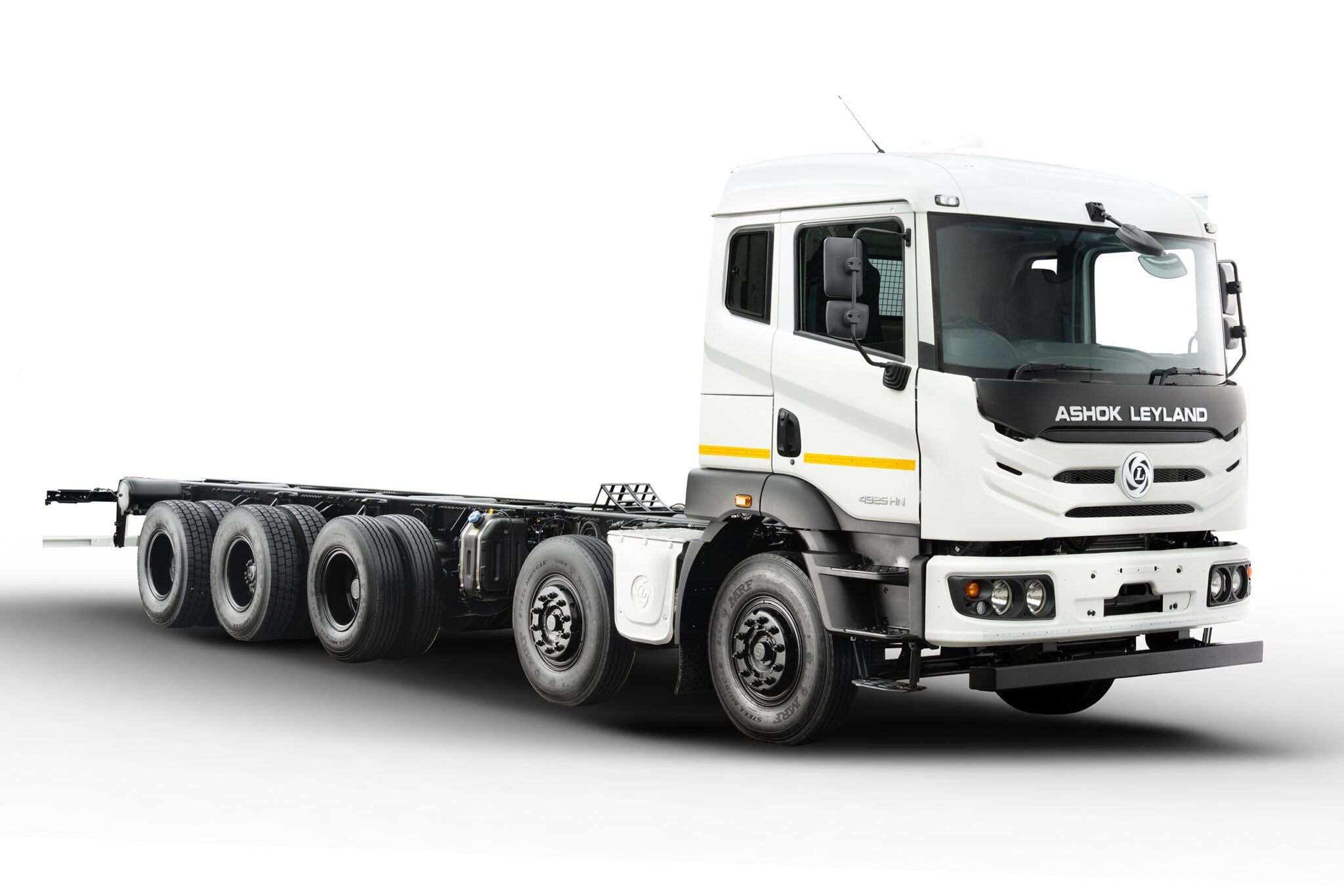
Ashok Leyland
The MD Who Said: We Will Not Be a Screwdriver Factory
THE MOMENT
It is 2007. The CEO of the Indian operations of a major European commercial vehicle manufacturer — a company with global scale, advanced technology, and decades of experience — pulls R. Seshasayee aside at an industry event. The tone is sympathetic.
His message is clear: Ashok Leyland cannot survive what is coming. Global competition is entering India. Ashok Leyland's technology comes from a British parent that is increasingly disinterested. Its manufacturing is concentrated in Chennai, which has chronic labour problems. The company should prepare for a managed decline.
Seshasayee listens. Then he goes back to work.
Fifteen years later, the European company's India operations had shrunk. Ashok Leyland had become the world's fourth largest bus manufacturer, the second largest commercial vehicle producer in India, and a company whose entirely indigenous Neptune engine was certified to international emission standards that the foreign advisers had said Indian manufacturers could not meet. The tables, as Seshasayee would later note drily, had turned.
The Turnaround at a Glance
Ashok Leyland
Timeline
1948
Ashok Motors founded in Chennai. Assembles Austin A40 cars from British kits
1955
Leyland Motors of UK buys stake. Company renamed Ashok Leyland
1987
British Leyland exits India. Hinduja Group acquires controlling stake for strategic revival
1998
R. Seshasayee becomes Managing Director. Launches technology self-reliance mission
2001
Hindustan Leyland Technology Centre inaugurated. Indigenous engineering programme begins
2005
'2020 Project' launched — in-house engine development from scratch, first in India for CVs
Before → After
Revenue
Net profit growth
Market cap
Technology ownership
The Playbook Move
The Playbook Move
PLAYBOOK MOVE 1: Face the Truth
“We always had a good reputation for robust, reliable products. But continuing to be tied down to foreign technology would eventually render AL uncompetitive. We took the risk, built a strong engineering team, and launched ourselves on a course of technological self-reliance.”
— R. Seshasayee, Former Managing Director, Ashok Leyland
THE COMPANY BEFORE
Ashok Leyland's origins in 1948 were straightforward: freedom fighter Raghunandan Saran responded to Prime Minister Nehru's call for industrial self-reliance by incorporating Ashok Motors in Chennai to assemble Austin cars. Within a few years, recognising that a developing country needs trucks and buses more than private cars, Saran entered into a partnership with Leyland Motors of the United Kingdom, and the company became Ashok Leyland.
For three decades, AL operated in the comfortable but constraining embrace of its British technology partner. The relationship provided access to Leyland's engineering know-how but also created a structural dependency: AL was essentially a licensed manufacturer of British designs adapted to Indian conditions. When British Leyland's global business deteriorated in the 1980s, the quality of technology transfer correspondingly declined.
The Hinduja Group's acquisition in 1987 injected new capital and strategic ambition, but the technology question remained unresolved. A partnership with Iveco of Italy replaced the British Leyland relationship. Iveco was more technically advanced than British Leyland had been in its final years, but it was still a foreign technology licensor — and an increasingly restless one, periodically pressing for majority control that the Hindujas had no intention of conceding.
By the time Seshasayee became MD in 1998, Ashok Leyland had a good reputation for vehicle durability, strong relationships with state transport corporations, and a culture of manufacturing discipline. It also had a technology stack it did not own and a geography — concentrated in Chennai's Ennore area — that made it perpetually vulnerable to labour disputes.
THE CRISIS
The crisis Ashok Leyland faced in the late 1990s was structural, not cyclical. Its northern and eastern market share had been ceded to Tata Motors for nearly four decades because the licensing regime in the 1950s had constrained AL's production capacity as a foreign-partnered company. The handicap had compounded over time: Tata Motors had built distribution networks, service infrastructure, and customer relationships across north and east India that AL could not match.
Then came the technology dependency problem. Every time Ashok Leyland wanted to develop a new product, it required either Leyland or Iveco's cooperation. The licensor controlled the pace of innovation. When Indian emission norms began tightening toward BS-III and BS-IV standards in the 2000s, AL faced the prospect of spending years waiting for foreign technology partners to develop compliant engines for Indian conditions — engines that might not be optimised for India's terrain, fuel quality, and climate.
Simultaneously, the commercial vehicle market was about to become genuinely competitive. Global manufacturers — Volvo, Mercedes-Benz, MAN — were entering India with premium products and manufacturing partnerships. They had technology advantages that AL could not match if it remained a screwdriver assembly operation.
Revenue in 1998 when Seshasayee took over was approximately ₹2,045 crore. The market cap was under ₹1,000 crore. Labour relations at the Ennore plant had a history of disruption. The company was profitable but had no pathway to the scale required to compete in the market that was coming.
THE LEADERSHIP DECISION
Seshasayee's founding decision was simple to state and enormously difficult to execute: Ashok Leyland would become technologically self-reliant. It would stop being a manufacturer of other companies' designs and become an original developer of its own.
The decision was not immediately popular with the Hinduja family, who had invested in the Iveco relationship and were understandably cautious about writing off that investment prematurely. Seshasayee's argument was direct: continuing to depend on foreign technology would eventually render AL uncompetitive. The only question was whether the break happened on their terms or on the terms of a crisis.
He was given the mandate and the budget to build an engineering capability from scratch. The Technology Centre was established. A team of engineers was hired and developed over several years. The '2020 Project' — an internal name for the indigenous engine development programme — was commissioned in 2005-06 under product development head M. Nataraj. The project started from a blank sheet of paper.
In parallel, Seshasayee made the geography decision. Rather than continuing to fight the labour relations problems at Ennore, he diversified the manufacturing footprint: a major production facility at Hosur in Tamil Nadu, a new plant at Pantnagar in Uttarakhand, which placed AL for the first time as a genuine pan-India manufacturer rather than a south India company that happened to sell nationally.
The third decision was the Iveco decision. In 2007, the Hindujas bought out Iveco's 15% stake rather than concede majority control. The price of full independence was high. The benefit was complete freedom — for the first time in fifty years, Ashok Leyland's technology destiny was entirely its own.
THE STRATEGIC PIVOT
The pivot was from licensed manufacturer to original equipment designer — and the proof point was the Neptune engine, launched in 2013 after eight years of development through the 2020 Project.
The Neptune engine was significant for multiple reasons. It was entirely designed and developed by Indian engineers for Indian conditions. It was certified to BS-IV emission norms — the standard that international consultants had told Ashok Leyland it could not meet without foreign technology. It incorporated common-rail fuel injection technology that conventional wisdom said could only be sourced from established European suppliers.
The conventional wisdom was wrong. Ashok Leyland's engineers, working without the safety net of a technology licensor, found solutions that were in some respects superior to the European alternatives. The in-line pump modification that met higher emission standards — dismissed by foreign competitors as not feasible — became a signature example of what Seshasayee called the company's audacity.
The product portfolio built around indigenous technology — U-Truck, Captain, Boss, Neptune — addressed segments from light commercial to heavy-duty haulage with products designed specifically for Indian road conditions, Indian fuel quality, Indian payload demands. Global products adapted for India were at a systematic disadvantage against Indian products designed for India from scratch.
MARKET REACTION
The immediate reaction to the technology self-reliance programme was internal scepticism as much as external. Senior engineers who had spent careers working with foreign technology manuals had to re-learn what it meant to own a problem rather than refer it to a licensor.
Fleet operators — the core AL customer base — took a cautious view of new indigenously developed products. Indian truck operators had learnt from experience that new product launches often meant the first buyers served as field-testing guinea pigs. AL had to earn trust in the Neptune engine by running extensive pre-launch trials and deploying strong after-sales support to the early adopters.
The competitive response from global entrants proved less damaging than the 2007 warning had predicted. Premium global brands captured the premium segment but found that Indian fleet operators buying trucks at high volume were far more interested in running costs, service network density, and spare parts availability than in brand prestige. On all three dimensions, AL's indigenous network advantages outweighed the technology premium of global entrants.
THE FACTORY FLOOR
Seshasayee's factory floor philosophy was built around what he called visible leadership. He understood that culture in a manufacturing organisation is made on the shop floor, not in strategy documents. He would regularly ride Ashok Leyland buses during his MD tenure — sitting with passengers, experiencing the product as the customer experienced it, gathering intelligence that no market research could replicate.
He would stop at truck dhabas on highways to talk to drivers about what they needed from their vehicles. A managing director stopping at a roadside restaurant to interview a truck driver was an unusual enough event to become an internal legend at AL — and to send an unmistakable signal about where the company's attention belonged.
The Hosur plant, built to complement and eventually reduce dependence on Ennore, became a model for what a modern Indian commercial vehicle plant could achieve. The Pantnagar facility in Uttarakhand — built under the Uttarakhand industrial incentive regime — made AL operationally competitive in north India for the first time.
The union engagement programme Seshasayee ran at the plant level — productivity agreements in exchange for wage increases, transparent communication during difficult quarters, consistent follow-through on commitments — produced a labour relations record in his MD tenure that contrasted sharply with the historical disruptions at Ennore.
THE RESULTS
The numbers Seshasayee left behind — turnover grown five times, net profit grown thirty times, market capitalisation grown fourteen times during his MD tenure — are among the most impressive operational records in Indian manufacturing history. But the less quantifiable achievement may be more important: the transformation of a licensed assembler into an original designer.
The European competitor who warned Seshasayee in 2007 that AL would not survive global competition was operating from a model of industrial competition that Ashok Leyland had made obsolete. A company that can design its own engines can compete on its own terms. A screwdriver factory cannot.
THE PLAYBOOK MOVE
PLAYBOOK MOVE 1: Face the Truth
The truth that Ashok Leyland had to face was uncomfortable: it was not really a manufacturer — it was a licensor's agent with good factory skills. Seshasayee faced that truth directly and built a decade-long programme to change it. Facing the truth does not mean accepting it. It means seeing clearly enough to know what must change, then doing the hard, expensive, multi-year work of changing it.
"We always had a good reputation for robust, reliable products. But continuing to be tied down to foreign technology would eventually render AL uncompetitive. We took the risk, built a strong engineering team, and launched ourselves on a course of technological self-reliance."
— R. Seshasayee, Former Managing Director, Ashok Leyland
FOR YOUR FACTORY:
How much of your factory's competitive capability do you actually own — and how much is rented from a licensor who could change the terms tomorrow?
THE LESSON
Technology dependency is competitive vulnerability. Own your technology or be owned by whoever does.
For forty years, Ashok Leyland was a sophisticated manufacturer of other companies' designs. Seshasayee's single most consequential decision was to fund an eight-year programme to develop an indigenous engine with no guarantee of success. The Neptune engine validated that investment. More importantly, the engineering capability built to create it became the platform for every product innovation that followed. You cannot be a manufacturing powerhouse if your technology decisions require someone else's approval.