
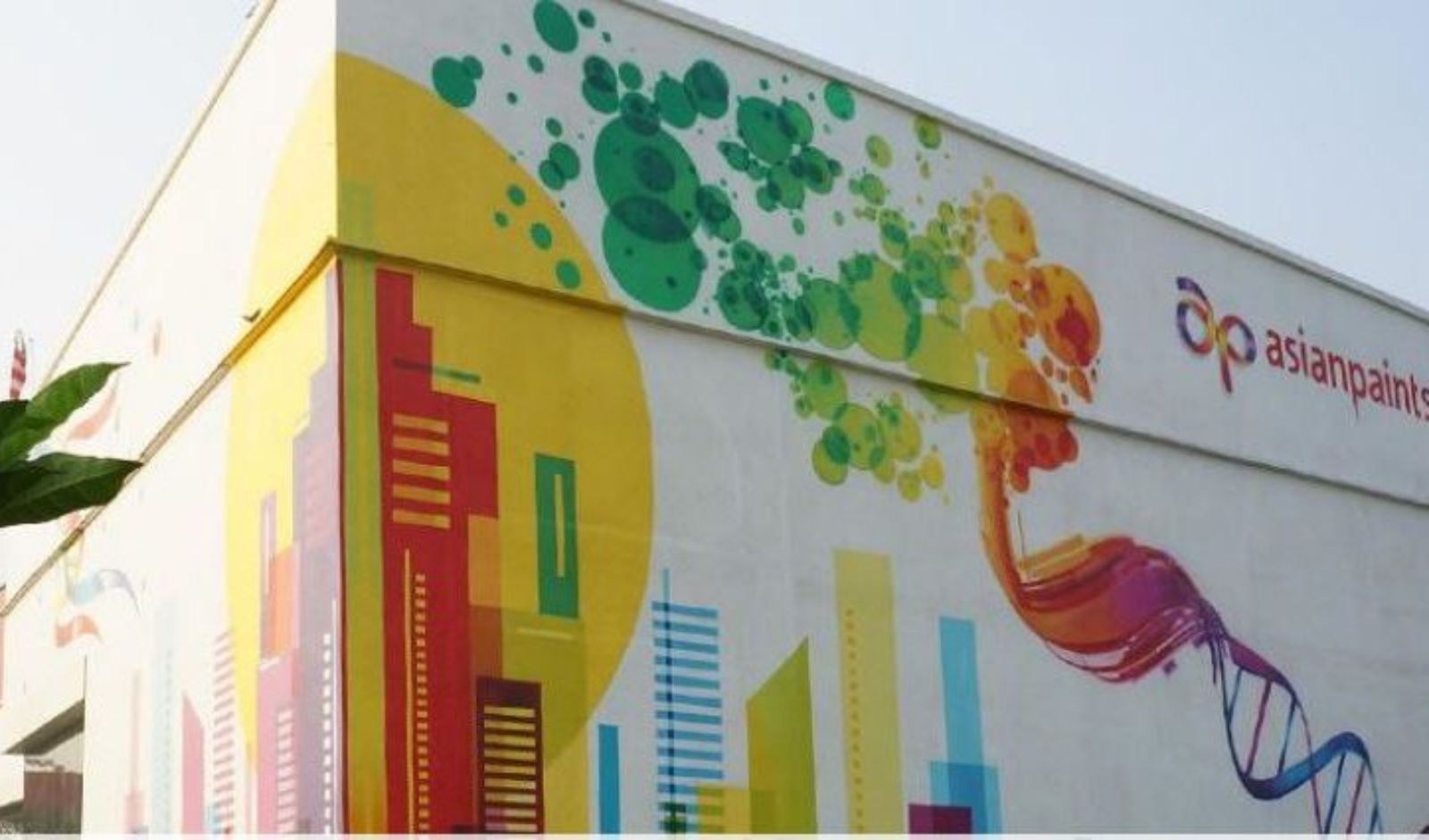
Asian Paints
The Paint Company That Built India's Most Fearsome Supply Chain
THE MOMENT
It is 1970. A paint company in Mumbai has just bought a supercomputer.
This requires explanation. In 1970, India does not have mainframe computing at the scale the West does. ISRO — the Indian Space Research Organisation — will not acquire a supercomputer for another decade. IIT Powai will not have one for ten years after that. No other Indian private company will own one for more than two decades.
Asian Paints has bought theirs to manage paint inventory.
To most observers at the time, this seems absurd. Paint is not a precision industry. Decorative paint is a commodity — you make it, you ship it, someone buys it to paint their house. The margins are thin, the competition is fierce, and the product is, at its core, coloured liquid in a tin. Why would a paint company need a supercomputer?
The answer to that question is the entire Asian Paints story. Because what Champalal Choksey and his co-founders had understood, and what their competitors had not, was that in a fragmented, geographically vast market with thousands of paint shades and millions of potential customers, the company that could predict demand, manage inventory, and deliver product faster and more reliably than anyone else would dominate. Not through a better product. Through better information.
That insight — pursued with a consistency that bordered on obsession for eight decades — built India's largest paint company.
The Turnaround at a Glance
Asian Paints
Timeline
1942
Founded from a garage in Mumbai by four entrepreneurs during WWII import ban
1965
Becomes Asian Paints (India) Private Ltd
1970
Purchases India's first supercomputer — a decade before ISRO — for ₹8 crore
1980
Bhandup plant runs at full capacity with 1,600 workers
1985
Ankleshwar plant achieves same capacity with fewer than 100 workers through automation
1983
First company in India to computerise its shop floor operations
Before → After
Factory workforce (same output)
Distribution cost (% of retail)
Dealer delivery frequency
Market share (organised decorative)
The Playbook Move
Move 7 — CONTROL THE VALUE CHAIN
Asian Paints is the definitive illustration of Playbook Move 7 applied to the distribution dimension of the value chain. By eliminating the wholesale distribution layer and building a direct relationship with 70,000+ dealers, the company took control of the most important interface in its business — the moment a dealer decides which brand to recommend to a customer.
“We bought a supercomputer in 1970 not because we loved technology. We bought it because we loved knowing more than our competition.”
— Ashwin Dani, Vice Chairman, Asian Paints
THE COMPANY BEFORE
Asian Paints was born in 1942 from a crisis. The Second World War had imposed import restrictions across British India, including on paint. Four young men — Champalal Choksey, Chimanlal Choksi, Suryakant Dani, and Arvind Vakil — saw a market that had been left without supply and moved to fill it, operating out of a garage in Mumbai.
Their early innovation was packaging. At a time when paint was sold in large tins — expensive, heavy, requiring dealers to hold substantial working capital — Asian Paints began selling paint in small packets. This single distribution innovation made the product accessible to a new class of customer: smaller retailers, rural shopkeepers, buyers who could not afford a full tin. It was not a technology decision. It was a distribution insight.
The company that emerged from those early years was commercially successful but not structurally distinctive. It had revenue. It had a growing dealer network. It operated in a market where the dominant players — large multinational paint companies — enjoyed enormous advantages in brand, technology, and financial resources.
Against that backdrop, the foundational challenge for Asian Paints was not how to make better paint. It was how to build a competitive advantage that the multinationals could not easily replicate. The answer the founders chose — and that subsequent leadership pursued — was supply chain and technology. In 1942, this was not an obvious choice. In retrospect, it was genius.
THE CRISIS
Asian Paints' existential challenge did not arrive in the form of a product failure or a financial collapse. It arrived in the form of a structural disadvantage: the company competed against multinational paint companies — ICI, Berger, Jenson & Nicholson — that had technology, brand, and capital advantages that should, by conventional analysis, have been impossible to overcome.
The paint market, moreover, was structurally difficult for any Indian manufacturer. Distribution to millions of small retailers across a geographically vast country, with thousands of colour variants and seasonal demand patterns, was operationally complex. The traditional model — large distributors holding extensive inventory, long credit periods, slow replenishment — tied up enormous amounts of working capital. Multinational companies with access to global capital could sustain these conditions. A family-owned Indian company could not.
The supply chain was also the competitive battlefield. Large distributors typically took 180 days of credit or more. If a paint company supplied ₹60,000 of paint to a distributor, that capital was locked for six months — and if you multiplied that across 1,000 distributors, you had ₹6 crore tied up in working capital with no productivity. For Asian Paints, competing against companies with far larger balance sheets, this was an existential challenge.
The crisis was not a dramatic moment. It was a slow-burning structural disadvantage that would eventually kill the company if the business model remained unchanged. The leadership's response — to invest in technology and data when no other company in India had conceived of doing so — was not a crisis response. It was a pre-emptive strike against the future.
THE LEADERSHIP DECISION
The ₹8 crore supercomputer in 1970 was the most audacious leadership decision in Asian Paints' history. To spend that sum — an enormous capital allocation for a paint company of that era — on computing infrastructure rather than on factories, products, or marketing required a clarity of strategic thinking that was, in the context of Indian manufacturing of the 1970s, without parallel.
The decision was Ashwin Dani's — son of co-founder Suryakant Dani, and the architect of Asian Paints' technology strategy. Dani's background was scientific: he combined his father's entrepreneurial instincts with formal training in chemistry and a precision-oriented mind. His insight was that demand forecasting and inventory management were the real constraints on profitability in the paint business — not manufacturing efficiency or product quality.
The supercomputer enabled something that no competitor had: the ability to forecast, by geography and by colour, what paint would sell on what day in which city. This transformed the distribution model. Instead of supplying large batches to distributors who then held inventory for months, Asian Paints could supply smaller quantities more frequently — directly predicting demand and replenishing accordingly. The distributor credit period shrank from 180 days to effectively zero. The working capital released was enormous.
Dani also made a second foundational decision: to bypass the traditional wholesale distribution layer entirely. Where other paint companies sold through large regional distributors who then supplied retailers, Asian Paints moved to direct supply — delivering paint directly to registered dealers, eliminating the 20% margin that intermediaries had previously extracted. This model required the data infrastructure to make it work. Without demand forecasting, direct distribution at scale was operationally impossible. With it, it was a devastating competitive advantage.
THE STRATEGIC PIVOT
The pivot was not from one product to another. It was from a conventional manufacturer's mindset to an information-management company that happened to make paint. Every decision Asian Paints made from the 1970s onward — in manufacturing, distribution, pricing, and marketing — was downstream of its investment in data.
The manufacturing pivot was the most immediately visible. In 1980, the Bhandup plant required 1,600 workers to operate at full capacity. When the Ankleshwar plant was commissioned in 1980, it achieved the same capacity with 250 workers. Five years later, the third generation of plants was running the same output with fewer than 100 workers. This was not the result of wage suppression or labour exploitation. It was the result of automation informed by precise data: when you know exactly what you will produce on any given day because your demand forecast is accurate, you can plan labour, materials, and equipment utilisation with a precision that eliminates waste.
The distribution pivot was equally radical. Asian Paints computerised its branch billing in the 1970s — the first company in India to do so — and used computers to generate daily stock position reports from every regional distribution centre. This meant the company's management knew, every morning, exactly where every litre of paint was in the supply chain. When competitors were managing inventory through paper-based systems with information lags of weeks, Asian Paints had real-time visibility.
By 2024, the system had evolved to its logical endpoint: Asian Paints delivers to over 70,000 registered dealers three to four times per day. The paint delivered each morning typically sells within three hours of arrival. Distribution costs, which industry competitors spend at 30-40% of retail price, run at 3% for Asian Paints. That 27-37 percentage point cost advantage is the direct result of six decades of compounding investment in supply chain technology.
MARKET REACTION
The market's reaction to Asian Paints' supply chain strategy was, for years, invisible. Supply chain improvements do not produce press releases. They produce slightly better availability at slightly better prices with slightly fewer stockouts. Competitors noticed the financial results — Asian Paints' growing profitability relative to peers — but struggled to replicate the capability, because the capability was the product of decades of data accumulation that could not be replicated in a single investment cycle.
The competitive response came in the form of consolidation. ICI India, recognising it could not match Asian Paints' distribution efficiency, attempted in 1997 to acquire a stake in the company — an approach that Ashwin Choksi and Ashwin Dani successfully repelled, characterising it as an attempt by a multinational competitor to acquire a market position it could not build on merit. Asian Paints eventually acquired ICI India's paint business in 2007 through its PPG joint venture, completing a competitive reversal that had seemed impossible in 1970.
The dealer network became the most durable expression of Asian Paints' competitive advantage. With 70,000+ registered dealers receiving multiple deliveries per day and benefiting from Asian Paints' unique service model — including credit support during disasters and emergencies — the company had built relationships that competitors found impossible to displace. Dealers who received reliable, frequent supply from a company they trusted were not inclined to switch for marginal product or price differences.
THE FACTORY FLOOR
The Asian Paints factory of 2024 is not recognisable as the same type of operation as the paint factories that existed in India in 1970. Automated storage and retrieval systems, installed from 2008, have eliminated much of the manual handling that characterised earlier operations. Automatic truck-loading systems at the Mysuru and Visakhapatnam plants process orders with a precision and speed that a human workforce cannot match.
The colour-matching technology that Ashwin Dani pioneered — computerised colour matching that enabled thousands of shades to be produced on demand rather than pre-manufactured — transformed the factory's role from a production unit to a customer-service platform. Instead of producing fixed palettes of colours and requiring customers to choose from them, Asian Paints could produce any colour a customer specified, tinting at the point of sale using base paints and colourants. This innovation eliminated the inventory obsolescence risk of pre-mixed colours and dramatically expanded the effective product range.
The inventory turnover ratio tells the factory floor story most clearly. Asian Paints turns its inventory 3.4 times per year — meaning it sells its entire stock roughly every 107 days. Competitor Berger Paints turns inventory every 141 days. That 34-day gap, multiplied across the entire product portfolio and supply chain, represents an enormous ongoing working capital advantage — built not by cutting corners but by knowing, with remarkable precision, what will sell before it is produced.
R&D, led in-house, developed the entire decorative coatings portfolio without dependence on foreign licensing — a deliberate choice to build manufacturing capability that was genuinely Indian. The SAP ERP system, implemented ahead of all competitors, connected factories, distribution centres, and dealer terminals into a single information ecosystem that the management could view in real time.
THE RESULTS
Asian Paints' results are best understood not as a single turnaround event but as the compounded effect of sixty years of better decisions in the same direction. Every percentage point of market share gain, every rupee of working capital freed, every distribution cost reduced — these were the products of the same insight, applied consistently across eight decades.
The company that four entrepreneurs started in a Mumbai garage to address a wartime paint shortage is today more than twice the size of its nearest Indian competitor, delivers paint to 70,000 dealers multiple times per day, and operates factories where machines know what they will produce before they produce it.
THE PLAYBOOK MOVE
Playbook Move 7 — CONTROL THE VALUE CHAIN
Asian Paints is the definitive illustration of Playbook Move 7 applied to the distribution dimension of the value chain. By eliminating the wholesale distribution layer and building a direct relationship with 70,000+ dealers, the company took control of the most important interface in its business — the moment a dealer decides which brand to recommend to a customer.
Value chain control in this case was not backward integration into raw materials or forward integration into retail. It was lateral integration into the information and logistics infrastructure that connected the factory to the customer. By owning the data, owning the delivery relationship, and owning the dealer loyalty, Asian Paints made itself structurally impossible to displace — not because its paint was dramatically superior, but because its supply chain was so much better that switching to a competitor meant giving up a service advantage that no competitor could match.
The 3% distribution cost vs 30-40% for competitors is the quantified expression of value chain control. Every rupee that competitors spend on distribution is a rupee Asian Paints can spend on product, marketing, or pricing. Compounded over sixty years of operations, that structural advantage has been worth more than any individual product innovation.
THE LESSON
The company that manages information better than its competitors will eventually outperform them on every other dimension. Asian Paints did not win because it made better paint. It won because it knew more — about demand, about inventory, about its customers — than anyone else.
The lesson from Asian Paints is not about paint. It is about the relationship between information and competitive advantage. In every manufacturing sector, there are companies that are information-rich and companies that are information-poor. The information-rich companies make better decisions, operate more efficiently, and compound advantage over time. The information-poor companies make decisions on instinct and lose ground slowly, then suddenly.
Asian Paints chose information over intuition before computers were standard business tools. That choice required courage and capital — the ₹8 crore supercomputer in 1970 was a massive bet. But it was a bet with a specific hypothesis: that better data would produce better distribution, and better distribution would produce better margins. The hypothesis was correct. The discipline to keep investing in the capability over decades was the real achievement.
For Indian manufacturers: what does your company know, systematically, that your competitors do not? If the answer is 'nothing particularly different,' then Asian Paints' story is a challenge. The competitive advantages that compound over decades are built on information, not on products.
In your manufacturing operation, which part of the value chain do you currently not control — and if a competitor controlled it before you did, what would that cost you?