
THE MOMENT
It is 2012. DefenceExpo, Pragati Maidan, New Delhi.
Bharat Forge has brought its first artillery gun to the exhibition. The team has spent years developing it — drawing on decades of metallurgical expertise, forging capability, and the engineering instinct that comes from building precision components for the world's most demanding automotive manufacturers. The gun is real. It works. It has been tested. By any objective measure of manufacturing capability, it represents something India has never built before: a 155mm artillery system, designed and made entirely in the private sector, at a price point half that of imported equivalents.
Baba Kalyani stands near his exhibit and watches.
Indian Army officers walk past. Some glance. Most do not stop. Some laugh. Not a single one pauses to examine what Bharat Forge has built. The reason, as Kalyani will later describe it, is not technical scepticism. It is categorical disbelief — the deeply embedded conviction of a defence establishment that has spent decades buying from global suppliers that no Indian private company could possibly build something as complex as a gun system.
'They just believed that global suppliers were the best,' Kalyani said. 'Not a single guy stopped to even see what the hell it was.'
That moment of dismissal — in a public hall, in front of a product that would go on to be exported to foreign armies and celebrated as a Make in India success — is the compressed story of what Bharat Forge had to overcome. Not a technology gap. Not a cost problem. A credibility problem so deep it required a change of government policy and a decade of persistence to unlock.
The Turnaround at a Glance
Bharat Forge
Timeline
1961
Founded by Nilkanthrao Kalyani in Pune. Auto component forging
1972
Baba Kalyani joins. Begins transformation from domestic to export focus
1990s
Becomes largest forging company in India. 100% auto-sector dependent
2008
Global financial crisis. Auto sector collapses. Revenue halved overnight
2011
Baba Kalyani pitches defence manufacturing to PM Manmohan Singh — no response
2012
Exhibits first artillery gun at DefenceExpo Delhi. Army officers laugh and walk past
Before → After
Revenue Concentration
Defence Revenue
Artillery Gun Exports
Global Ranking (Forging)
The Playbook Move
Move 6 — EARN GLOBAL VALIDATION
Bharat Forge's chapter illustrates Playbook Move 6 with a specific and instructive twist: the global validation arrived before the domestic one.
“We make guns at half the price of imports. Price is not the problem. The problem was that nobody believed we could do it. We proved it anyway.”
— Baba Kalyani, Chairman & MD, Bharat Forge
THE COMPANY BEFORE
Bharat Forge was founded in 1961 by Nilkanthrao Kalyani in Pune, manufacturing forged components for the Indian automotive industry. When Baba Kalyani — MIT-educated, son of the founder — joined in 1972, the company was a solid domestic auto components supplier with genuine manufacturing capability but limited ambition for the global stage.
Over the following two decades, under Baba Kalyani's leadership, Bharat Forge was systematically transformed into an export-oriented precision engineering company. The strategy was clear: build manufacturing capability to global standards, pursue quality certifications that would satisfy the world's most demanding customers, and win supply contracts with the major automotive OEMs in Germany, North America, and Japan.
By the early 2000s, the strategy had worked comprehensively. Bharat Forge had become the largest forging company in India and one of the largest in the world. Its customers included virtually every major global automotive manufacturer — Daimler, BMW, Volkswagen, Ford, General Motors, Caterpillar. It had acquired companies in Germany and Sweden, giving it manufacturing presence in the heart of Europe's automotive supply chain. Its crankshafts, front axle beams, and connecting rods were in vehicles on every road in the world.
The company was, by 2007, a remarkable Indian manufacturing success story. It was also, dangerously, dependent on a single sector for the overwhelming majority of its revenue. Automotive was everything. The forging capability was world-class. The customer concentration was an existential risk waiting for a trigger.
In 2008, the trigger arrived.
THE CRISIS
The 2008 global financial crisis was, for the automotive industry, a near-extinction event. Vehicle sales collapsed in North America and Europe with a speed and scale that no planning scenario had modelled. General Motors filed for bankruptcy. Ford survived only because it had taken on debt before the crisis to fund a restructuring. The European automotive market contracted sharply. Assembly lines that had been running at full capacity stopped.
For Bharat Forge, which supplied critical components to the automotive sector across three continents, the impact was immediate and severe. Revenue fell approximately 30-40% within months. The order book that had been the foundation of the company's growth trajectory evaporated as customers deferred purchases, cancelled contracts, and scrambled to survive their own crises.
The Pune manufacturing facilities, built and equipped for a sustained high-volume automotive supply business, were suddenly running at a fraction of their capacity. A workforce trained in precision forging for automotive applications had no customers to forge for. The capital investment in Germany and Sweden — strategic acquisitions made at the peak of the automotive boom — now looked like liabilities.
The crisis exposed what Baba Kalyani had already known intellectually but now experienced viscerally: a company with 100% automotive exposure was not a diversified manufacturing company. It was an automotive company that happened to use forging technology. The distinction mattered enormously when the automotive cycle turned.
The question that the 2008 crisis forced was not merely how to survive the downturn. It was how to build a company that would not be this vulnerable to a single sector's cycle again. The answer Baba Kalyani had been developing for years — defence manufacturing — was about to become urgent.
THE LEADERSHIP DECISION
The idea of Bharat Forge entering defence manufacturing had been in Baba Kalyani's mind long before the 2008 crisis accelerated it. His logic was straightforward to the point of being obvious, once stated: artillery systems are, at their core, precision forging projects. The metallurgical knowledge, the engineering capability, the tolerance standards, the manufacturing discipline required to build a high-performance gun barrel are precisely the capabilities that Bharat Forge had spent four decades developing for automotive crankshafts and axle beams.
The barrier was not technical. It was structural. India's defence manufacturing sector was a public sector monopoly. Ordnance factories and defence public sector units (DPSUs) held every contract. Private companies were not permitted to manufacture weapons systems. The technology transfer India had received from Sweden's Bofors in the 1980s — a complete package for manufacturing the 155mm Bofors gun domestically — had produced not a single gun, because private sector participation was blocked.
Kalyani tried every available channel. He approached Prime Minister Manmohan Singh directly. He was redirected to Defence Minister A.K. Antony. He met the minister, made his case for fifteen minutes, and received no response. He went to bureaucrats, submitted proposals, attended policy consultations. The defence establishment's position was essentially unchanged: this is a government domain, private companies are not part of it.
His response to this institutional wall was to build the capability anyway — not because he had a contract, not because he had government permission, but because he had the conviction that India's defence manufacturing needed private sector participation and that Bharat Forge was specifically equipped to provide it. Kalyani Strategic Systems was established. The artillery programme was funded from Bharat Forge's own resources. The engineering team began development.
The 2012 DefenceExpo was the first public demonstration of what that investment had produced. The army officers who laughed were, in Kalyani's telling, not wrong to be sceptical — they had spent careers in a system that had given them no reason to believe Indian private companies could build weapons systems. What they could not know, walking past the Bharat Forge exhibit in 2012, was that the policy environment that had sustained their scepticism was two years from changing.
THE STRATEGIC PIVOT
Bharat Forge's strategic pivot had two simultaneous dimensions — one defensive, one offensive — and understanding both is essential to understanding the transformation.
The defensive pivot was diversification away from automotive dependency. The 2008 crisis had made the concentration risk undeniable. Bharat Forge systematically expanded its forging capability into oil and gas components, power generation equipment, railway components, construction and mining equipment, and aerospace structures. Each of these sectors required the same precision forging capabilities the company had built for automotive. Each had different demand cycles. The portfolio diversification that resulted made the company structurally more resilient — less vulnerable to any single sector's fluctuation.
The offensive pivot was the defence programme — the decision to invest, without government contract or policy support, in developing indigenous weapons systems. This was not a hedge or a pilot. It was a conviction investment. Kalyani structured it through Kalyani Strategic Systems Limited (KSSL), a wholly owned subsidiary, keeping the defence development work focused and separately accountable.
The artillery system development drew directly on Bharat Forge's metallurgical knowledge base. Gun barrels are among the most demanding forging applications in the world — they must withstand extreme pressure, temperature, and repetitive stress cycling. The material science, heat treatment protocols, and non-destructive testing systems that Bharat Forge had developed for automotive applications were directly applicable. The gun was not built despite Bharat Forge being a forging company. It was built because of it.
When Narendra Modi's government launched Make in India in 2014 and the Defence Procurement Policy was reformed in 2016, the policy environment finally caught up with the investment Bharat Forge had been making for years. KSSL — which had been building capability in anticipation of a market that did not yet officially exist — was immediately positioned to participate in the new procurement landscape. The company that had been told there was no room for it in defence had been ready for years before the door opened.
MARKET REACTION
The market reaction to Bharat Forge's defence ambitions evolved from dismissal to validation over approximately a decade — a timeline that tested the conviction of everyone involved.
The 2012 DefenceExpo moment was the nadir: a product that genuinely worked, built by one of India's most capable manufacturing companies, ignored by the very customers it was designed for. The institutional credibility of imports was so deeply embedded in India's defence procurement culture that domestic capability — even when demonstrably available — could not initially be seen.
The shift began after 2014. As government policy changed, as Make in India created new requirements for domestic sourcing, as the Indian Army began to engage with private sector suppliers seriously for the first time, Bharat Forge's accumulated investment began to convert into contracts. The same artillery system that army officers had walked past in 2012 was, by 2022, fulfilling a $155 million export contract — guns that India was selling to foreign armies, including Armenia.
International buyers, unencumbered by the domestic defence establishment's historical biases, evaluated the Bharat Forge product on its merits. The guns worked. They were priced at half the cost of Western imports. The metallurgical quality was demonstrably world-class. By 2024, KSSL had exported 100 artillery guns and carried an order book of $600 million. The product that soldiers had laughed at in 2012 was being bought by foreign armies in 2024.
THE FACTORY FLOOR
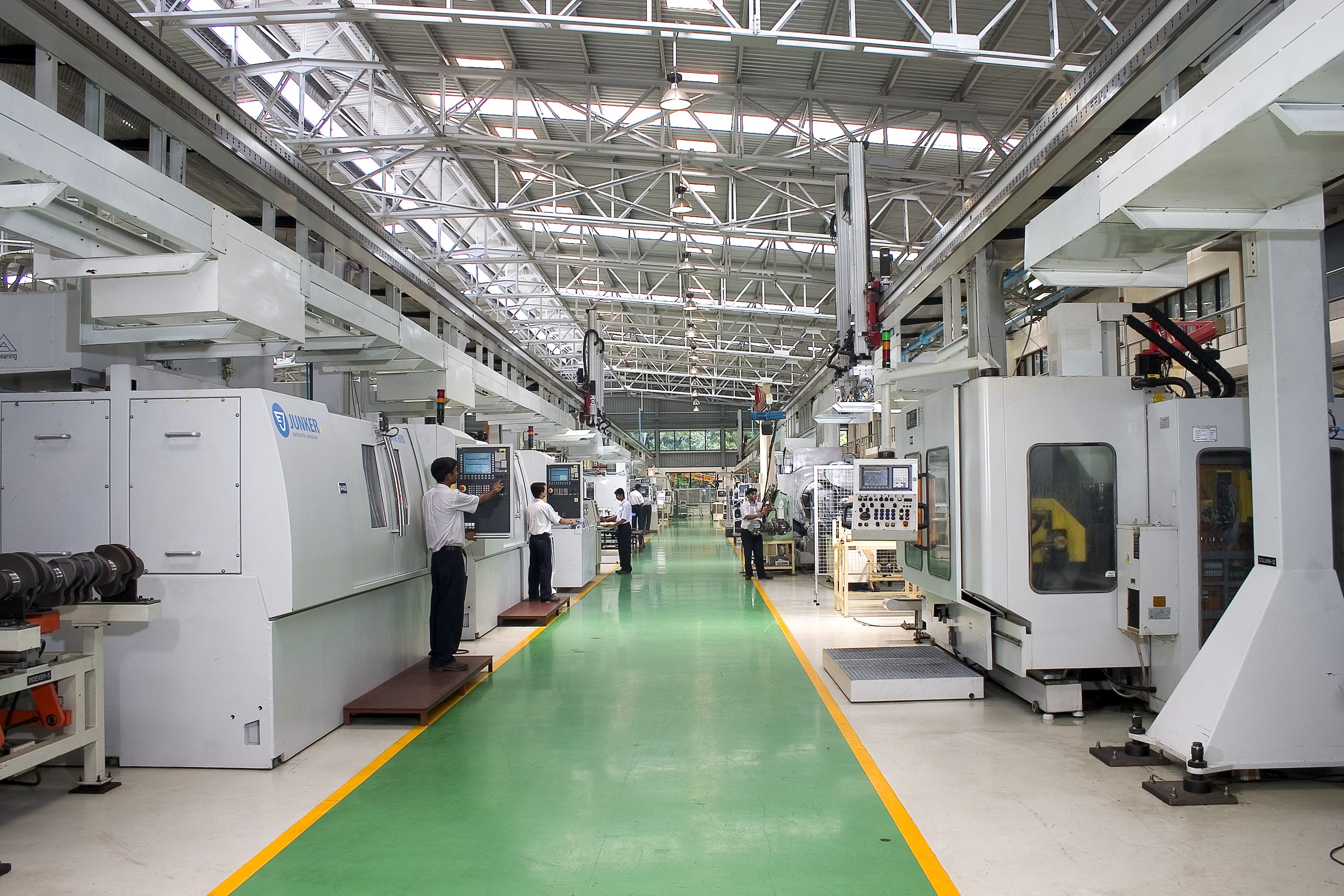
Bharat Forge's factory floor story is a story of capability transfer — the application of precision manufacturing disciplines built for one sector to the entirely different requirements of another.
The Pune manufacturing complex, which produces forged components for the world's major automotive OEMs, operates to tolerances and quality standards that very few Indian manufacturing companies match. The material certification processes, the dimensional inspection systems, the statistical process control methods, the metallurgical testing protocols — these were developed over decades to satisfy the demands of German, American, and Japanese automotive customers who inspect supply chains with a thoroughness that leaves no room for variation.
Transferring this capability to artillery manufacturing required adaptation but not reinvention. A gun barrel's metallurgical requirements — the grain structure of the steel, the consistency of the heat treatment, the dimensional accuracy of the bore — are demanding in ways that are different from a crankshaft but not more demanding than one. What the Bharat Forge team had built for automotive gave them the foundation for defence.
The Industry 4.0 investments Bharat Forge made through the 2010s added a layer of manufacturing intelligence that further strengthened the platform. Zero unplanned downtime — Baba Kalyani's challenge to his team — required sensor-based equipment monitoring, predictive maintenance systems, and real-time process data that gave the manufacturing organisation visibility into equipment health that had previously been unavailable. These systems, deployed across the automotive forging lines, were equally applicable to defence production.
The Kalyani Centre for Technical Innovation (KCTI) and Kalyani Centre for Manufacturing Innovation (KCMI) formalised what had previously been informal: the systematic investment in R&D capability that could generate proprietary manufacturing processes rather than simply executing established ones. For a company moving into defence, where indigenous technology development was now a government requirement, this capability was essential.
THE RESULTS
The numbers that matter most in the Bharat Forge story are not the revenue figures. They are the sequencing: a company that had zero defence revenue in 2010 carrying a $600 million defence order book in 2024. That is not a pivot. That is a new business, built inside an existing company, against institutional resistance, funded from internal resources, validated by the global market before the domestic one.
The automotive diversification has been equally consequential. Bharat Forge today is the world's second-largest forging company — behind only ThyssenKrupp of Germany — with manufacturing operations across India, Germany, Sweden, France, and North America. The company that was devastated by automotive sector concentration in 2008 now has a portfolio diversification that makes it structurally resilient across multiple economic cycles.
THE PLAYBOOK MOVE
Playbook Move 6 — EARN GLOBAL VALIDATION
Bharat Forge's chapter illustrates Playbook Move 6 with a specific and instructive twist: the global validation arrived before the domestic one.
It was not the Indian Army that first validated Bharat Forge's artillery capability. It was foreign buyers — Armenia and an unnamed Middle Eastern country — who evaluated the product without the institutional biases of the domestic procurement system and found it to be world-class. The $155 million export contract of 2022, and the 100 guns exported in 2024, were the global market's verdict: this product competes with the world's best, at half the price.
That global validation then fed back into domestic credibility. The Indian Army, which had walked past the exhibit in 2012, began to engage seriously with KSSL in a way that would not have happened without the international track record. The export success became the domestic marketing.
For Indian manufacturers who feel dismissed by domestic customers — government, institutional, or commercial — the Bharat Forge model is directly applicable. Sometimes the path to domestic credibility runs through global validation first. The international customer who has no historical bias, who evaluates purely on product merit, may be the one who tells your home market what you are actually worth.
THE LESSON
The capability your company has built for one customer can be more valuable in a different market than anyone — including the government — is currently willing to acknowledge. Build the capability first. The market will arrive.
Bharat Forge's story is, at its core, a story about the gap between capability and credibility. In 2012, Bharat Forge had the capability to build artillery systems. The credibility — in the eyes of the defence establishment — was zero. The conventional response to this gap is to wait for credibility to arrive before investing in capability. Kalyani did the opposite: he invested in capability in the conviction that credibility would eventually follow.
The period between 2008 and 2016 — from the crisis that made diversification urgent to the policy change that made defence manufacturing possible — required a sustained investment in the absence of immediate commercial return. For a publicly listed company with shareholders expecting quarterly results, this kind of patient capital allocation is not easy to justify. Kalyani justified it by treating the defence programme not as a business development exercise but as a manufacturing capability that would eventually find its market.
The lesson is not specific to defence. It applies to any manufacturer who has built a capability in one sector and can see its application in another. The barriers are real — institutional, policy-based, credibility-based. They are also temporary. The company that builds the capability before the barriers fall is the company that captures the market when they do.
What manufacturing capability does your company have that a different sector, a different customer, or a different geography would value — and are you waiting for permission to pursue it, or building it while you wait?