
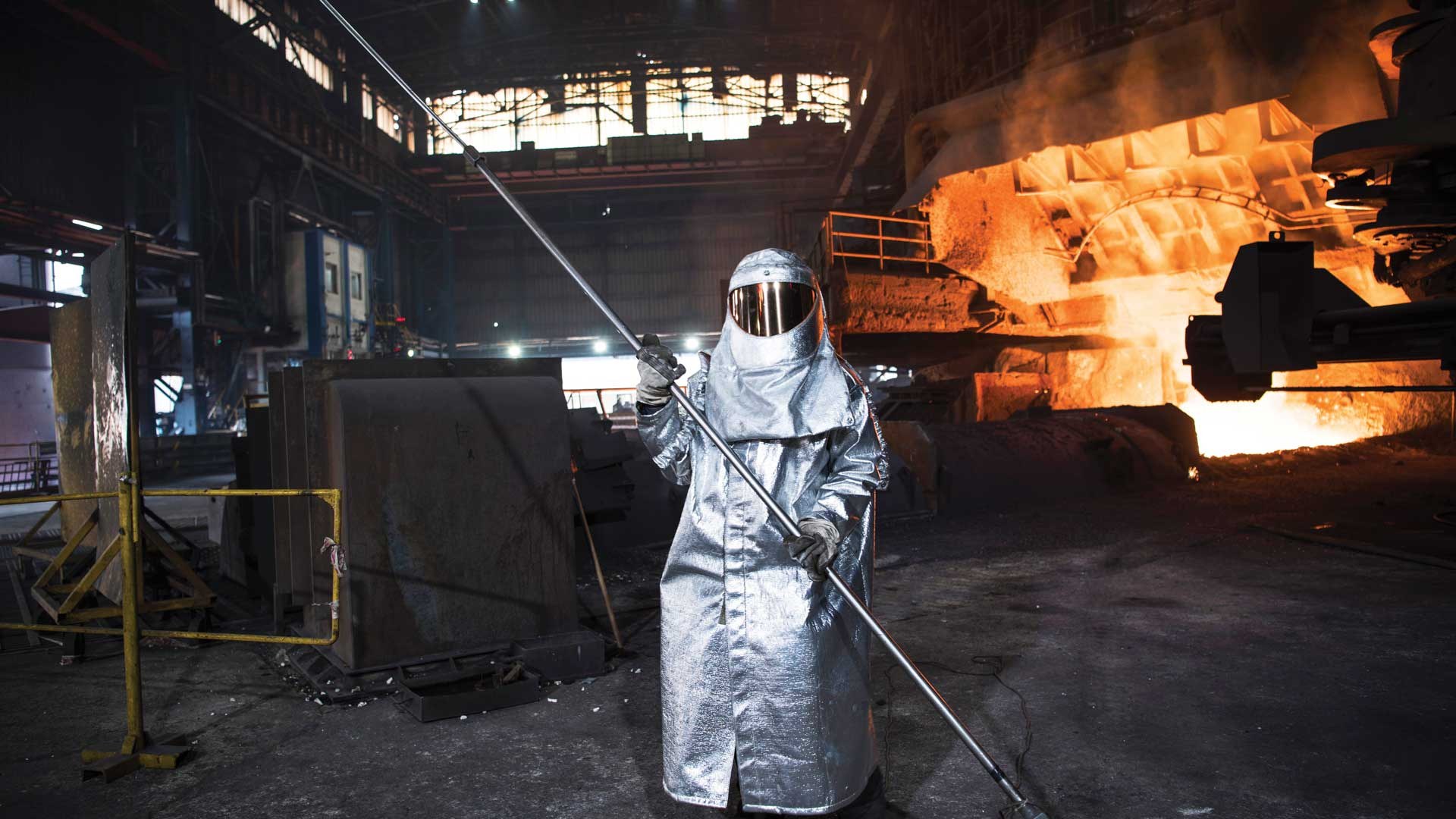
THE MOMENT
The consultant's report lands on Ratan Tata's desk in 1992, and its conclusion is blunt enough to read standing up.
Arthur D. Little, one of the world's most respected management consulting firms, has been commissioned to assess Tata Steel's competitiveness in a newly liberalised India. Their finding: the company cannot compete. Its costs are too high. Its technology is outdated. Its productivity is below international benchmarks. Against the imports that liberalisation will now allow in, Tata Steel will not survive.
The recommendation is unambiguous: close Tata Steel.
Ratan Tata refuses. This is not stubbornness. It is a recognition that a recommendation to close is not a strategy for survival — it is an abdication of the problem. The recommendation is accepted for a different purpose: Ratan Tata asks the consultants to deliver the message directly to the leadership team in Jamshedpur. Not softened, not mediated. The full force of it, face to face with the people who will have to respond to it.
What happens next is one of the most complete operational transformations in Indian industrial history. The same team that had been told their company was not viable would spend the next decade building one of the lowest-cost, highest-quality steel operations in the world.
The consultants were right about the diagnosis. They were wrong about the only possible response to it.
The Turnaround at a Glance
Tata Steel
Timeline
1907
Founded by Jamsetji Tata in Jamshedpur. India's first integrated steel plant
1991
Liberalisation. Arthur D. Little report recommends closing Tata Steel
1992
Dr. J.J. Irani launches TQM transformation. Cost reduction begins
2000
Steel cost falls to $160/tonne — one of lowest in world
2001
B. Muthuraman takes over. Global ambition accelerates
2004
Acquires NatSteel, Singapore. First international acquisition
Before → After
Steel Cost per Tonne
Ranking — World Producer
Tonnes per Employee
Quality Awards
The Playbook Move
Move 1 — FACE THE TRUTH
Tata Steel's chapter is the purest illustration of Playbook Move 1 in this book. The company did not face the truth gradually or partially. It faced it completely — in the form of a third-party report that recommended closure, delivered without softening to the people who would have to respond to it.
“The consultants said close Tata Steel. We decided to use their diagnosis as a starting point, not an ending point.”
— Dr. J.J. Irani, Former Managing Director, Tata Steel (paraphrased)
THE COMPANY BEFORE
Tata Steel was founded in 1907 by Jamsetji Tata in Jamshedpur, making it one of the oldest and most historically significant industrial enterprises in India. For most of its first eight decades, it operated in a protected market where the primary competitive requirement was reliability of supply, not efficiency of production. The steel industry was tightly regulated. Imports were restricted. Demand frequently exceeded supply. Tata Steel, like most Indian industrial companies of the era, optimised for output rather than cost.
By 1991, the company was producing approximately 2 million tonnes of steel annually and employed tens of thousands of workers in Jamshedpur. It was a city within a city — hospitals, schools, townships, civic infrastructure, all maintained by the company. The social obligations were real and enormous. The idea that Tata Steel might not survive was not merely a financial question. It was a question about an entire community.
The liberalisation of 1991 changed the rules of the game entirely. Imports became possible. Global steel producers with far more efficient operations — Japanese, Korean, European — could now compete on price in the Indian market. Tata Steel's cost structure, built for a protected environment, was not competitive in this new world. In 1991, Tata Steel's cost of producing a tonne of steel was significantly above global benchmarks. The productivity of its workforce, by international standards, was low. The technology in parts of the plant was ageing.
The stock market responded accordingly. In the early 1990s, the prevailing investment community sentiment was captured in a phrase that became well-known: 'Say Tata to Tata' — meaning sell your Tata stocks, because companies like Tata Steel had no future in liberalised India.
THE CRISIS
The crisis Tata Steel faced after 1991 was not a sudden collapse. It was a slow suffocation — the gradual recognition that the company's fundamental cost position made it uncompetitive in the world it now had to operate in.
The Arthur D. Little assessment quantified what insiders already sensed. The gap between Tata Steel's production costs and international benchmarks was not a gap that could be closed with minor adjustments. It required a fundamental rethinking of how the company operated — its processes, its productivity norms, its quality standards, its relationship with its suppliers, and its deeply embedded organisational culture.
The scale of the challenge was compounded by the company's social commitments. Jamshedpur was not just a factory. It was a planned city of over 600,000 people, with Tata Steel at its centre. Any drastic restructuring carried social consequences far beyond a balance sheet adjustment. This reality had, over decades, created a culture in which difficult operational decisions were softened by institutional loyalty and community obligation. That culture — admirable in its intent — had contributed to a cost structure that was now existentially dangerous.
Labour productivity was a specific problem. By international benchmarks, Tata Steel was producing significantly fewer tonnes of steel per employee per year than global competitors. The technology in parts of the plant required capital investment that would take years to justify. Quality consistency — critical for the automotive and engineering customers whose business Tata Steel needed to grow — was below what global buyers expected.
The investment community's verdict was harsh but not unfounded. The question facing Dr. J.J. Irani, who led the transformation, was not whether the problems were real. They were. The question was whether a company with this history, this workforce, and this community obligation could be made genuinely competitive — not just in India, but in the world.
THE LEADERSHIP DECISION
Dr. Jagannath Jamnadas Irani — Dr. J.J. Irani — took the Arthur D. Little report not as a death sentence but as a diagnostic. In his framework, the consultants had done Tata Steel a service by quantifying exactly how far the company needed to travel. The destination was clear. The path had to be built.
His decision was to launch a Total Quality Management transformation — not as a programme or an initiative, but as a fundamental cultural shift. TQM, as Irani implemented it, was not a quality control system. It was a philosophy: that every process in the company could be measured, analysed, improved, and measured again. That the distance between where the company was and where it needed to be was not a structural impossibility but a series of specific problems that could be identified and solved.
The decision had a direct operational target. Tata Steel needed to become one of the lowest-cost steel producers in the world — not in India, not in Asia, but globally. Irani set this target explicitly. The organisation would be measured against international benchmarks, not domestic ones. The standard would be the best steel producer in the world, not the best steel producer in Jamshedpur.
This decision required something more difficult than a strategy document: it required the leadership team to be honest, publicly and consistently, about how large the gap was and how much work closing it would require. The Arthur D. Little report, delivered directly to the Jamshedpur team, served this purpose. It was not comfortable. It was necessary.
Ratan Tata's role in this transformation was to provide the mandate from the top and the protection from the bottom. He refused to close the company when external advice said to. He also refused to shield the organisation from the truth about its competitive position. Both refusals were essential.
THE STRATEGIC PIVOT
The strategic pivot Tata Steel executed under Dr. Irani was not a product pivot or a market pivot. It was an operational pivot — a systematic, decade-long effort to close the gap between the company's cost position and the world's best.
The TQM transformation had specific dimensions. Labour productivity was addressed through workforce restructuring — not mass retrenchments, but a combination of voluntary retirement schemes, natural attrition, and redeployment into higher-value activities. Over the course of the 1990s, the headcount was reduced while output increased, improving the crucial tonnes-per-employee metric dramatically.
Technology investment was prioritised in areas where the productivity and quality return was highest. The blast furnaces, the rolling mills, the quality testing systems — each was upgraded with an explicit linkage to cost per tonne and quality standard improvement.
Supplier relationships were rebuilt on the same TQM principles. The raw material base — iron ore and coking coal — was analysed for cost and quality. Supply chain decisions were made not on historical relationships but on what the numbers supported.
By the year 2000, the result was measurable and extraordinary. Tata Steel's cost of producing a tonne of steel had fallen to approximately $160 — compared to Corus's cost of $540 per tonne at the same period. The company that had been recommended for closure in 1992 had become one of the lowest-cost steel producers in the world. The stock market that had told investors to 'Say Tata to Tata' was now reassessing its position.
MARKET REACTION
The market reaction to Tata Steel's transformation came in stages, and the early stages were sceptical.
The investment community that had dismissed Tata Steel in the early 1990s was slow to revise its view. The TQM transformation, by its nature, does not produce dramatic announcements or single headline moments. It produces quarterly improvements in cost metrics and quality data that accumulate over years before their full significance becomes visible.
The domestic steel market, opened to imports, initially provided the most demanding test. Global steel brands, arriving with price competition, forced Tata Steel to compete on quality and reliability rather than the captive relationships of the licence raj era. The automotive sector — where quality consistency is non-negotiable — became a critical proving ground. Tata Steel's ability to win and retain automotive supply contracts through the 1990s and early 2000s was the market's verdict on the quality transformation.
The global reaction came later, and more dramatically. When Tata Steel acquired NatSteel in Singapore in 2004 and Corus in the United Kingdom in 2007, the international response was initially incredulous — a mid-sized Indian steel company acquiring one of the great names of British industrial history, at a price of $12 billion. The Corus acquisition would prove to be a mixed outcome: profitable in the first two years, then devastated by the 2008 financial crisis, then a decade of losses in the European operations. But the Indian business — the one built on the TQM foundation — remained one of the world's most competitive steel operations throughout.
THE FACTORY FLOOR
The Tata Steel transformation of the 1990s is fundamentally a factory floor story, and it is worth dwelling on what actually changed in Jamshedpur during those years.
TQM at Tata Steel was implemented through a methodology that involved every level of the organisation — from the managing director's office to the furnace operator on the night shift. Quality circles, small groups of workers meeting regularly to identify and solve operational problems in their specific area, became standard practice. The data produced by these circles — on yield, on scrap, on process deviations, on equipment reliability — fed into a continuous improvement system that identified where the largest cost and quality gains were available.
The blast furnace operations were a particular focus. The cost of producing molten iron — the primary input into steelmaking — is the largest single cost driver in an integrated steel plant. Coke rate (the amount of coke consumed per tonne of iron produced), blast temperature, raw material consistency, and furnace productivity were all measured against international benchmarks and improved systematically. By the late 1990s, Tata Steel's blast furnace productivity was among the best in Asia.
Maintenance systems were overhauled. Unplanned downtime — the enemy of steel plant productivity — was reduced through preventive maintenance programmes that required workers to understand and monitor the health of their equipment, not merely operate it. The cultural shift this required was significant: it asked the workforce to take ownership of assets that had previously been the domain of the maintenance department.
Energy efficiency was another systematic focus. Steel plants are enormous consumers of energy. Every improvement in energy use per tonne of steel produced is a direct cost reduction. Waste heat recovery, process optimisation, and energy monitoring systems were implemented across the plant, producing cumulative savings that contributed significantly to the cost reduction journey.
THE RESULTS
The numbers that matter most in the Tata Steel story are the cost-per-tonne comparison. In 2006, Tata Steel's Indian operations produced steel at $160 per tonne. Corus, the company Tata was about to acquire, produced steel at $540 per tonne. This was not a marginal difference. It was a 3.4x cost advantage that testified to the depth and durability of the operational transformation Dr. Irani and his team had achieved over fifteen years.
The Indian operations' profitability remained robust through the Corus difficulties, through two global economic downturns, and into the 2020s. In FY2021, Tata Steel posted the highest profits in the Tata Group — a validation of the operational foundation built in the 1990s that survived every external shock thrown at it.
THE PLAYBOOK MOVE
Playbook Move 1 — FACE THE TRUTH
Tata Steel's chapter is the purest illustration of Playbook Move 1 in this book. The company did not face the truth gradually or partially. It faced it completely — in the form of a third-party report that recommended closure, delivered without softening to the people who would have to respond to it.
The power of this approach is not comfortable to describe. Telling a workforce that they are not competitive, that their company has been assessed as unviable, that the gap between where they are and where they need to be is enormous — this is not a motivational speech. It is an act of respect. It treats the workforce as adults capable of responding to difficult information with capability rather than collapse.
Every factory in India has a gap between its current performance and what international benchmarks suggest is achievable. Most factory owners know this gap exists. Fewer know its precise dimensions. Fewer still are willing to share those dimensions with the people who could close it. The first move in every turnaround this book examines is the willingness to face the truth — not eventually, not partially, but completely, and with the people who matter most.
THE LESSON
A diagnosis of terminal decline is not a verdict. It is a starting point — but only for the leader who is willing to share the diagnosis honestly with the people who must respond to it.
The Arthur D. Little report could have been used in two ways. It could have been used to justify closure — to tell the workforce that external experts had confirmed what management already suspected, and that the decision to wind down was validated by independent analysis. Ratan Tata chose the other use: he made the report a catalyst for transformation by putting it directly in front of the people who had the capability to disprove it.
This is the leadership move that the turnaround literature almost never discusses. Not the strategy. Not the investment. Not the technology choice. The decision to be honest, openly and without softening, about how bad things actually are — and to trust that the people in the organisation are capable of responding to that honesty with something better than despair.
Tata Steel's workforce in Jamshedpur had every reason to resist the transformation. The social obligations were real. The historical pride was real. The institutional resistance to change was real. What Dr. Irani gave them, alongside the honest diagnosis, was a framework for improvement and the conviction that improvement was achievable. The TQM system was not imposed on the workforce. It was given to the workforce as a tool. The difference between those two approaches is the difference between a restructuring and a transformation.
What is the honest assessment of your factory's competitiveness against the best in your industry — and who in your organisation has been given that assessment in full?