
Larsen & Toubro
The Two Danish Engineers Who Built India's Industrial Spine
THE MOMENT
It is 1940. Two Danish engineers, stranded in India by the Second World War, look at the disrupted supply chain around them and decide to build something.
Henning Holck-Larsen and Soren Kristian Toubro had come to India to represent a Danish dairy equipment company. Their original plan was to sell European machinery to Indian customers, collect commissions, and return home. The war closed that option. European goods could no longer be imported. Their principals had no products to send. The men were left in Bombay with engineering skills, no supply chain, and a market that desperately needed what they could no longer get from abroad.
They did not go home. They set up a workshop.
That decision — to stop being traders and become manufacturers, in a country not their own, during a global war — is the founding decision of what would become India's most complex engineering enterprise. Larsen & Toubro today builds nuclear plants, metro rail systems, defence platforms, smart cities, and offshore oil platforms. It employs over 50,000 engineers. It operates in 50 countries. Its order book exceeds ₹5 lakh crore.
All of it traces back to two men who, in 1940, decided to make things rather than sell them.
The Turnaround at a Glance
Larsen & Toubro
Timeline
1938
Henning Holck-Larsen and Soren Kristian Toubro arrive in India as engineers
1940
WWII disrupts supply chains. The duo sets up a small engineering workshop in Mumbai
1946
L&T formally incorporated. Begins manufacturing dairy equipment and industrial valves
1950s
Wins first large government contracts. Builds capability in EPC (Engineering, Procurement, Construction)
1969
Licence Raj peak — L&T navigates extreme regulation with technical excellence
1990s
Post-liberalisation. Faces competition from global engineering firms entering India
Before → After
Revenue
Order Book
International Presence
Defence/Aerospace
The Playbook Move
Move 4 — REINVENT THE PRODUCT
L&T's reinvention was not of a single product but of the company's fundamental offering — from manufacturer of components to deliverer of complete solutions. The Playbook Move 4 insight here is that 'the product' in a manufacturing business is not always what comes out of the factory. Sometimes it is the service, the system, the turnkey solution that the factory capability enables.
“We did not come to India to build a company. We came to fix a problem. But we could not stop fixing problems. That is what engineers do.”
— Henning Holck-Larsen, Co-Founder, Larsen & Toubro
THE COMPANY BEFORE
The early L&T was a precision engineering company operating in the interstices of the Licence Raj. It made dairy equipment, valves, switchgear, and industrial instruments — products that India needed in large quantities but could not reliably import. The company's competitive advantage in the 1950s and 1960s was not financial or political. It was technical: Larsen and Toubro brought European engineering standards to a market that had been starved of precision manufacturing.
The Licence Raj era was a structural advantage and a structural constraint simultaneously. On one hand, import substitution industrialisation meant that companies which could manufacture technically complex products domestically faced little foreign competition. On the other hand, the licence system constrained capacity expansion, product diversification, and the speed of decision-making. L&T, operating in capital goods and industrial equipment, navigated this environment through the quality of its work — winning government contracts not through political relationships but through demonstrated technical capability.
Henning Holck-Larsen retired in 1978. The company he left was prosperous, technically respected, and deeply embedded in India's industrial infrastructure. But it was also heavily dependent on the protected domestic market and had not yet developed the project management capability — the ability to execute large, complex, multi-year projects involving thousands of contractors, suppliers, and regulators — that would define L&T's next phase.
The question that liberalisation in 1991 posed was sharp: in an open market, where global engineering firms could compete for Indian contracts, could L&T survive on technical quality alone? The answer would determine whether it remained a respected domestic manufacturer or became a global engineering powerhouse.
THE CRISIS
The 1991 liberalisation and its aftermath posed an existential competitive challenge to L&T. Global engineering and construction companies — Bechtel, Fluor, ABB, Siemens — could now bid for Indian infrastructure projects that had previously been L&T's protected domain. These companies brought global project management systems, international financing relationships, and portfolios of completed projects that demonstrated capability at scales India had not yet seen.
Simultaneously, L&T faced an internal challenge: the company had grown through the Licence Raj era as a collection of manufacturing divisions, each operating somewhat independently, without the integrated project delivery capability that large EPC contracts required. Building a power plant, a refinery, or a metro system required not just engineering competence in individual disciplines, but the ability to manage the interfaces between them — the procurement, the scheduling, the quality assurance — as a single integrated system.
The financial pressures compounded the structural ones. The early 2000s were difficult years for Indian industry. Infrastructure spending was constrained by fiscal pressures. Private investment was slow. L&T's order books were thinner than its capacity warranted, and the company's diversification into computers, cement, and financial services — undertaken in the 1990s as a hedge against dependence on the core engineering business — was producing mixed results.
By 2003, it was clear that a strategic inflection was needed. The company that had prospered under protection had to decide what kind of company it wanted to be in a competitive, open economy. That decision fell to A.M. Naik.
THE LEADERSHIP DECISION
A.M. Naik joined L&T in 1965 as a graduate engineer. He rose through the company over four decades, understanding every division, every factory floor, every project execution challenge from the inside. When he became Group Chairman in 2003, he brought to the role something that no outside consultant could have provided: a complete understanding of where L&T's real strengths lay.
Naik's foundational decision was focus. L&T had diversified into areas — computers, cement, finance — that were not connected to its core engineering and manufacturing capability. These businesses consumed management attention and capital that could have been deployed in the core. Naik made the difficult decision to exit them, concentrating the company's resources on what it was uniquely equipped to do: complex, large-scale engineering and construction.
The second leadership decision was investment in project management systems. Naik understood that L&T's transition from a manufacturer to a full EPC (Engineering, Procurement, Construction) company required not just engineering capability but the organisational systems to manage programmes of extraordinary complexity. He invested in processes, technologies, and training that systematically upgraded L&T's project execution capability to global standards.
The third decision was one that most Indian CEOs of his generation would not have made: to actively seek the most complex, highest-risk projects in India rather than wait for easier contracts. Naik's belief was that L&T's competitive advantage would only be built by doing work that no one else could do. Every time L&T delivered a nuclear plant, a defence platform, or a metro system that had never been built in India before, it built capabilities that competitors could not purchase or replicate quickly.
THE STRATEGIC PIVOT
The pivot from protected domestic manufacturer to global EPC company happened on three axes simultaneously: capability, geography, and complexity.
On capability, L&T invested heavily in technology centres, R&D facilities, and partnerships that upgraded its engineering competence into domains it had not previously served. The defence and aerospace thrust — triggered by India's growing ambition for domestic defence manufacturing — required L&T to build capabilities in systems integration, precision manufacturing, and quality standards that were entirely new. The nuclear energy programme required engineering precision and quality assurance at standards that exceeded anything L&T had previously delivered.
On geography, L&T systematically built an international presence, executing projects in the Middle East, Africa, and South Asia. International projects were harder — logistically, commercially, and operationally — than domestic ones. But they built a portfolio and a reputation that changed how global clients and partners perceived the company. L&T was no longer an Indian company that built things in India. It was an engineering company that built complex things wherever it was asked.
On complexity, the Naik strategy was explicit: L&T would move up the value chain, away from commodity construction work and toward the most technically demanding projects in the economy. Metro systems, high-speed rail, nuclear plants, submarines, fighter jet components, smart city infrastructure — these projects carried higher margins, required deeper capability, and produced learning that could not be acquired any other way.
MARKET REACTION
The international engineering firms that had entered India post-liberalisation expecting to dominate Indian infrastructure found a more formidable domestic competitor than they had anticipated. L&T's combination of local knowledge, deep supplier relationships, regulatory expertise, and technical capability proved more durable than its foreign competitors had assumed.
In the defence sector, where India's Make in India policy created opportunities for domestic manufacturers, L&T's investment in capability positioned it ahead of competitors who had to start from zero when the policy changed. When the Ministry of Defence began requiring domestic content in platforms, L&T was ready. Competitors were not.
The market's financial verdict has been clear. L&T's revenue grew from approximately ₹12,000 crore in 2003 to over ₹2.2 lakh crore in FY2024 — a compounding growth rate of approximately 17% per year for two decades. The order book — the forward visibility of future revenue — exceeded ₹5 lakh crore in 2024, representing more than two years of current revenue in confirmed work.
Institutional investors, initially sceptical of a diversified industrial conglomerate competing in domains as different as IT, nuclear power, and metro rail, eventually came to understand that the diversity was the strategy — that L&T's ability to offer integrated solutions across multiple engineering domains gave it a competitive position that no single-domain competitor could threaten.
THE FACTORY FLOOR
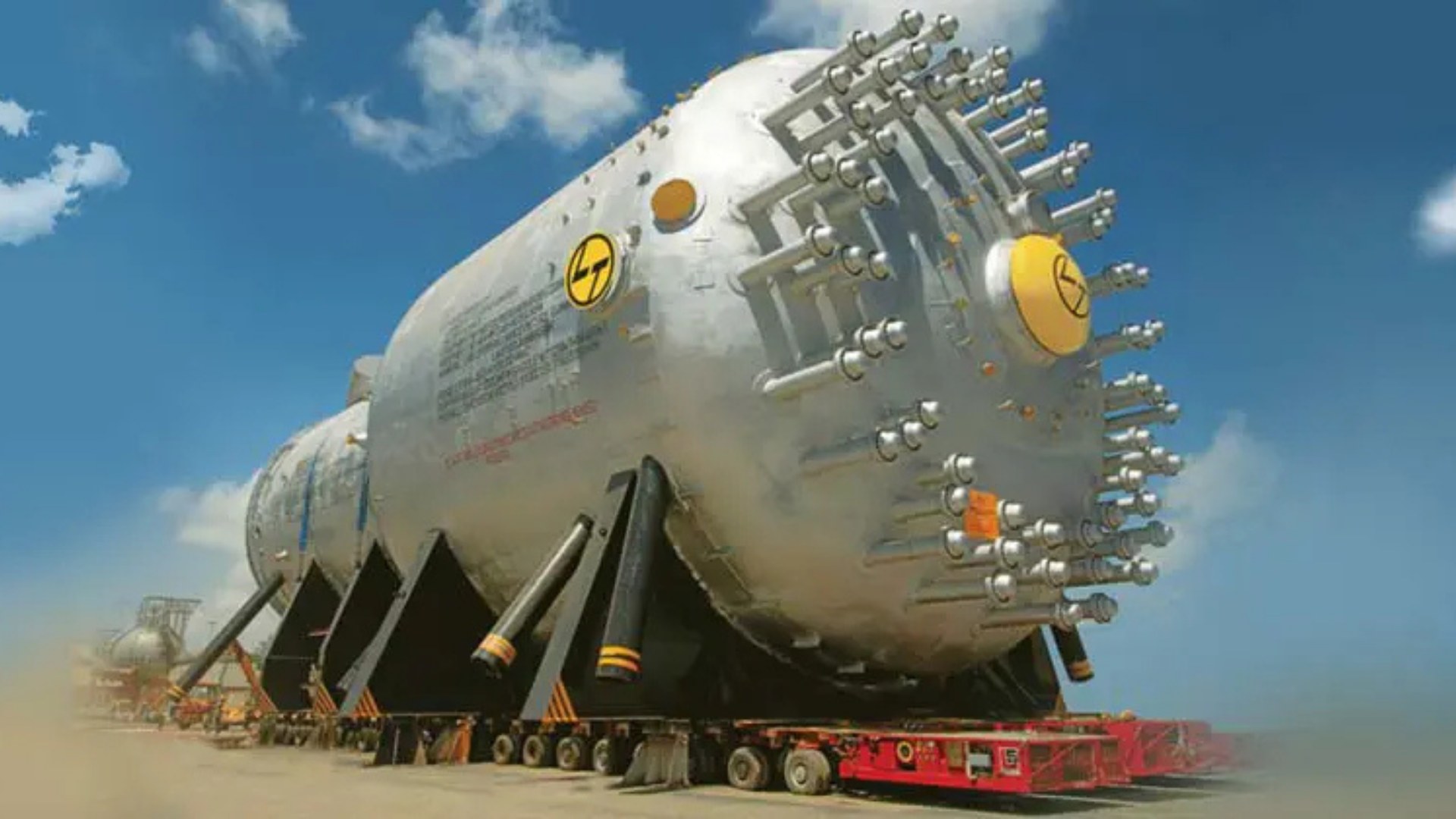
L&T's factories are not conventional manufacturing facilities. The Hazira manufacturing complex in Gujarat — spanning heavy engineering, ships, hydrocarbon processing equipment, and power equipment — is among the most technically diverse manufacturing operations in the world in a single location. Products manufactured there range from heat exchangers the size of a house to precision components measured in microns.
The quality systems at L&T's manufacturing facilities are, in many domains, the most stringent in India. Nuclear components — manufactured at L&T's Heavy Engineering facility — require quality assurance processes that go beyond any commercial manufacturing standard. Every weld is traceable. Every material certificate is documented. Every dimension is verified against specifications set not just for function but for the 60-year operational life of a nuclear plant.
The modular construction approach L&T pioneered for offshore platforms — building complex assemblies on-shore and then installing them at sea — reduced installation time, improved quality, and dramatically lowered cost compared to traditional at-sea fabrication. This innovation, borrowed from global offshore engineering practice and adapted for Indian conditions, became the standard for Indian offshore projects.
The defence manufacturing facilities built for programmes like submarine construction and missile systems represent an entirely new category of manufacturing capability for India. Submarines are among the most complex manufactured objects in existence — thousands of systems that must all function reliably in a high-pressure, hostile environment for decades. Building the infrastructure and processes to manufacture them is a decade-long institutional undertaking. L&T built it.
THE RESULTS
L&T's transformation from a domestic capital goods manufacturer to a global engineering enterprise is one of the most comprehensive corporate reinventions in Indian business history. The company did not change what it was — an engineering organisation with extraordinarily high technical standards — but it systematically extended that identity into new domains, geographies, and scales of complexity.
The numbers are important. But the more significant result is the institutional capability L&T has built — a reservoir of engineering knowledge, project management systems, supplier relationships, and technical reputation that took seven decades to accumulate and that no competitor can replicate in a short time frame.
THE PLAYBOOK MOVE
Playbook Move 4 — REINVENT THE PRODUCT
L&T's reinvention was not of a single product but of the company's fundamental offering — from manufacturer of components to deliverer of complete solutions. The Playbook Move 4 insight here is that 'the product' in a manufacturing business is not always what comes out of the factory. Sometimes it is the service, the system, the turnkey solution that the factory capability enables.
L&T reinvented its product from 'we make engineering components' to 'we deliver complete engineered systems — on time, to specification, at global quality standards.' That reinvention required the same underlying manufacturing capability but added project management, supply chain integration, regulatory expertise, and financial engineering that the factory alone could not provide.
The result is a company that competes not on unit cost but on total delivered value — a very different and much more defensible competitive position. No competitor can undercut L&T on a nuclear plant contract by buying cheaper steel. The value L&T delivers is not in the materials. It is in the certainty of delivery of an incredibly complex system to standards that brook no error.
THE LESSON
Excellence in one domain, relentlessly extended into adjacent domains, builds a compound advantage. L&T did not diversify away from engineering. It diversified deeper into it — into every corner that engineering could reach.
The L&T lesson is about the compounding power of technical reputation. When a company builds a genuine capability — not a claimed one, but one proven by delivered results — and then applies that capability to progressively more complex problems, it builds something that money cannot easily buy: trust based on performance.
Every nuclear plant L&T delivers makes it easier to win the next one. Every defence platform it builds makes the next one lower-risk for the client. Every metro system it completes adds to a portfolio that tells future clients, unambiguously, that this company has done this before. The portfolio becomes the sales force. The past performance becomes the competitive moat.
For Indian manufacturers aspiring to move up the value chain, the L&T story is a challenge to take on harder work rather than safer work. The most complex, most demanding projects are the ones that build capability. The comfortable projects are the ones that erode it.
What is the most complex project your factory has ever attempted — and did it build capability that your competitors cannot buy?